
Reviewed · KILMAINHAM & 1916 HISTORY
1916 Rebellion Walking Tour
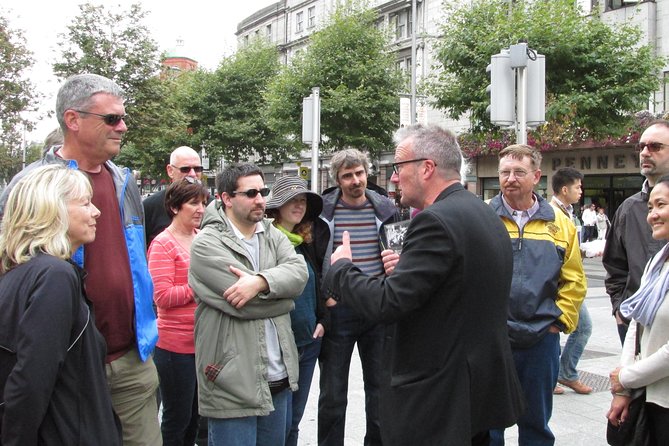
A week in Dublin gives you plenty of pubs. This tour gives you the reasons behind them. The 1916 Rebellion Walking Tour strings together landmark after landmark—from Lorcan Collins’ 1916 meet-up at the International Bar to the GPO—and tells how Ireland moved from hunger, to rising anger, to the Easter Week Rising. I love two things most: the way you see history close up (including bullet holes on memorials) and the conversational teaching style that keeps questions flowing. The one thing to keep in mind is that the official timing is about 2 hours, but if the group has lots of questions, it can stretch a bit.
This walk is built for real learning without a big museum setup. You get a professional guide, a route through major sites, and you don’t have to pay admission at each stop since the tour lists admission ticket free for what you visit. It also keeps the group size under control—up to 30 people—so it still feels personal rather than rushed.
I also like the pre-walk option: arrive early at the 23 Wicklow St meeting point, grab a drink if you want (alcohol is available for purchase), and skim the intro literature your guide provides. It’s a small touch, but it helps you get your bearings fast before you start marching through Dublin’s revolutionary streets.
In This Review
- Key Things I’d Prioritize
- Starting at 23 Wicklow St: the International Bar sets the tone
- The build-up from the Great Hunger to Easter Week
- Stop at City Hall: the Irish Citizen Army in Easter Week
- Dublin Castle: British administration and the years around 1916
- Four Courts from the bridge: how 1916 connects to 1922
- O’Connell Monument: bullet holes and the positions of both sides
- Jim Larkin Statue: working-class connections, Irish-Spirit solidarity
- The GPO and Easter Week’s center stage
- Moore Street: the last stand if time allows
- Bank of Ireland and the old Parliament feel
- What the tour feels like: pacing, group size, and questions
- Price and value: about $27.81 for major landmarks
- Who should book this (and who might not)
- Should you book the 1916 Rebellion Walking Tour?
- FAQ
- How long is the 1916 Rebellion Walking Tour?
- What does the tour cost?
- Where do I meet the guide?
- Is the tour in English?
- Do I get a mobile ticket?
- Are alcoholic drinks included?
- Do I need prior knowledge to enjoy it?
- What major stops will I see?
- What happens if the weather is bad?
- Can I cancel for a full refund?
Key Things I’d Prioritize

- International Bar start with Lorcan Collins connection: this is where the tour tradition sits right in the middle of Dublin’s everyday life
- Famine-to-Rising background before you hit the main sites: you’re not memorizing names in a vacuum
- Landmarks you can actually stand in front of: bullet holes and key locations still visible in the city
- GPO as the emotional center of the story: Pearse reading the Proclamation is part of Dublin’s national memory
- Route flexibility so it doesn’t get stale: you’ll see a solid set of major stops, but the order can shift
- Freedom to ask questions as you go: the best moments come when you pause and talk, not just listen
The 1916 story, told a few more ways
- Dublin Private Highlights & History of 1916 Easter Rising Tour★ 5.0 · 154 reviews
- The History of Dublin With Locals: 1916 Easter Rising PRIVATE Tour★ 5.0 · 73 reviews
- Wicklow Historic Gaol: 1-Hour Tour★ 4.4 · 56 reviews
- Day Tour from Dublin to Wicklow: Cliffs, Heritage, Wildlife, Gaol★ 5.0 · 7 reviews
Starting at 23 Wicklow St: the International Bar sets the tone
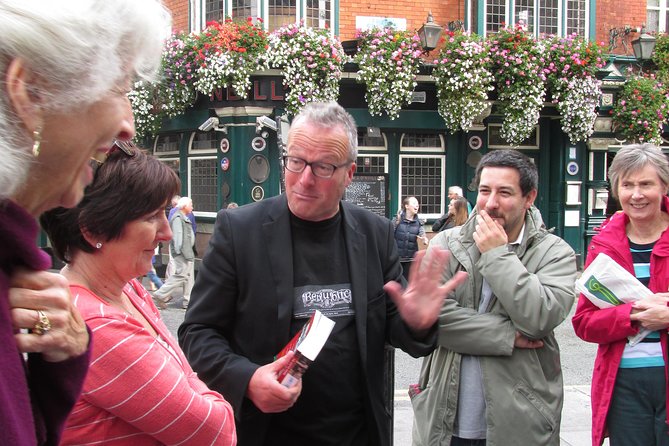
Your tour begins at 23 Wicklow St, Dublin. The meeting spot is the International Bar, a famous Dublin pub where Lorcan Collins has run the 1916 tour since 1996. That detail matters. It means you’re not just doing a “history walk” that could happen in any city. This is Dublin, and the story is being told from a place locals still treat as part of the social fabric.
If you can, arrive a little early. Your guide provides introductory literature, and you’re welcome to read it while you settle in. You can also have a drink before you start; alcohol isn’t included, but drinks are available for purchase. I like this start because it lowers the barrier. You’re not waiting outside in the cold trying to guess what’s coming next. You’re already in the right mood, with the basics in your hand.
Timing-wise, the tour is listed at about 2 hours. Still, plan like a real walking tour: expect some pauses, some short Q&A, and a few minutes to absorb what you’re seeing. Also, the tour requires good weather. If weather turns, you’ll be offered a different date or a full refund, so build a little slack into your Dublin schedule on this day.
The build-up from the Great Hunger to Easter Week
Before the walk really “fires,” the guide sets the stage. You start with a short introduction that connects the Great Hunger / Irish Famine of the 1840s to the revolutionary period, ending with the 1916 Rising. This is one of the tour’s smartest choices.
A lot of 1916 stories get told like a sudden explosion. This tour explains how people got to that point. That background helps if you’re a beginner. It also helps if you’ve already read a bit, because you get a clear chain of cause-and-effect rather than scattered facts.
This first segment also gives you a simple way to interact. The guide encourages questions early, and you get time to get to know them before you start covering ground. In practice, that means the rest of the tour is easier to follow: when you reach a monument or a government building, you already know what question you’re trying to answer.
Finally, route basics are explained so you’re not left guessing. You’ll learn what kind of path you’ll follow, and you’ll see major sites along the way. The tour also notes that routes can vary, which helps keep repeat visits from turning into the same script every time.
Stop at City Hall: the Irish Citizen Army in Easter Week
One of the clearest “in-the-city” moments comes at City Hall. During the 1916 Rising, this was occupied by the Irish Citizen Army. That’s a detail you can’t really get from photos. Standing near the building gives the story physical weight.
The guide uses this stop to explain how Easter Week wasn’t only about a few dramatic speeches. It was also about controlling space—where people gathered, what institutions were threatened, and how authority was challenged.
A potential drawback here: City Hall is part of the city’s active life. You’ll be stopping briefly, then moving on. So if you’re the type who wants to linger for a full, slow photo session, keep your expectations aligned with a walking-tour pace. The upside is that you see several key points rather than spending all your time on one.
Dublin Castle: British administration and the years around 1916
Next up is Dublin Castle. This is where the British administration controlled Ireland, and the guide connects it directly to what happened in 1916 and also the War of Independence that followed.
You might recognize Dublin Castle from the Michael Collins movie. Even if you do, this stop is still worth your attention because the tour uses the location to show how power worked in real life: offices, symbols of authority, and how revolutionaries viewed the state’s presence.
Here’s what makes this stop valuable for most people: it turns a landmark into an explanation. Instead of just pointing, the guide helps you understand why revolutionaries targeted sites like this. That context makes the later stops feel less random and more like a planned sequence in history.
More Dublin walks at an easy pace
Four Courts from the bridge: how 1916 connects to 1922
At Four Courts, the story becomes more complicated—in a good way. The building was occupied by revolutionaries in 1916 and again during the build-up to the Irish Civil War in 1922.
But you don’t actually walk right up to the building. The tour keeps it practical: it’s best seen from a bridge over the River Liffey, and that’s where the guide discusses its role in 1916 and 1922. The guide also explains the “intricacies” of the Civil War, which is where many first-time visitors feel the timeline wobble.
This is one of those moments where you’ll get the most value if you ask questions. If you’ve heard simplified versions of Irish revolutionary history, the Four Courts stop is where nuance starts to matter—different groups, shifting alliances, and the way conflict evolved after Easter Week.
O’Connell Monument: bullet holes and the positions of both sides
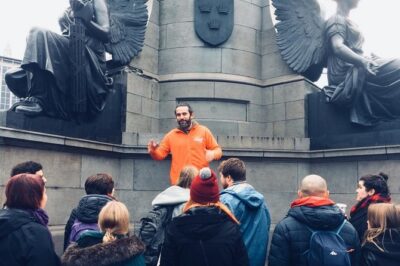
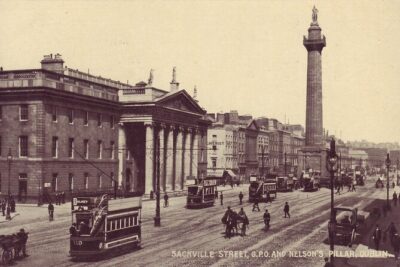
Then you reach a stop that can feel eerie in a straight-up, physical way: O’Connell Monument. There are bullet holes from the Rising still visible, and the guide uses them to explain the positions of the British and the Irish in 1916.
This is the kind of detail that sticks. It’s not abstract. It’s not a timeline on a slide. It’s evidence you can see right where people stood. Even if you know the broad story, these visible marks can change how you feel about it.
The tour also includes small stops along the route, not just the big “poster” landmarks. That matters because the story becomes more connected. You feel like you’re walking through a chain of moments rather than hopping between unrelated sites.
Jim Larkin Statue: working-class connections, Irish-Spirit solidarity
At the Jim Larkin statue, the guide highlights Big Jim Larkin, a union man from Liverpool and a comrade of James Connolly. This stop adds something many “rebellion” tours leave out: the working-class networks behind political action.
It’s also a neat reminder that revolutionary movements aren’t confined by national borders. Here, the story links Dublin’s labor world with a broader Irish diaspora connection through Larkin’s background and influence.
You’ll get a short stop—about 15 minutes—so this isn’t a full biography. But it’s enough to give you the bigger picture: revolutionary history isn’t only leaders and speeches. It’s people organizing, building solidarity, and pushing for change.
The GPO and Easter Week’s center stage
The tour’s most important stop is the An Post General Post Office (GPO). This is presented as the HQ for the revolutionaries in Dublin, and it’s also described as one of Dublin’s most important and historic buildings.
If you only remember one fact from the tour, it should be this: P.H. Pearse read the Proclamation at the GPO. That makes the building more than a “set.” It’s part of Ireland’s national psyche, and the guide treats it that way—by walking you through what happened during Easter 1916 and why it mattered.
You’ll spend around 30 minutes here, giving you time to absorb both the story and the place. That’s also where a good guide earns their pay. The GPO can’t fully explain itself. You need the bridge between what you see (a grand city building) and what it meant (a command center during a defining week).
If you want the tour to work well for you, this is the stop where you should stay present: look around, notice the mood, and let the guide’s narrative give the building its weight.
Moore Street: the last stand if time allows
Depending on timing, the tour may also go to Moore Street. The guide uses it to describe where the GPO garrison made their last stand in Easter Week.
This stop is a “maybe,” so don’t structure your whole day around it. But if you get there, it adds sharp closure. You go from the GPO as a symbolic HQ to the idea of a final stand—how the conflict shaped the route of the week and the fate of the people inside it.
For practical reasons, Moore Street also helps you see how quickly “historic sites” blend into everyday Dublin streets. That contrast is part of what makes this kind of walk so effective. You can feel the past in the present without having to travel out of the city.
Bank of Ireland and the old Parliament feel
Another stop you might see is the Bank of Ireland, which is more colloquially known as the Old Parliament. Depending on the day’s route, the guide may examine the building and explain its role in Irish history, along with its neighbor Trinity College.
This is where route variation shows up again. The tour makes a point that it changes—so you’re not always walking the exact same line no matter what day you booked. The good part: you’re still likely to see key sites. The tradeoff: you can’t guarantee every single listed stop if the schedule tightens.
If you’re a first-timer, don’t worry about that. The overall story arc is coherent even with route differences. You’ll still end back where you started.
What the tour feels like: pacing, group size, and questions
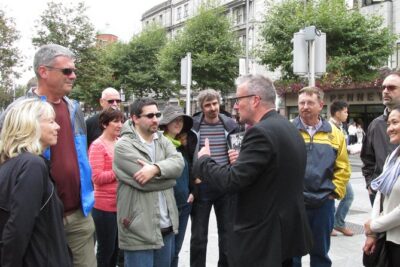
The tour caps at 30 travelers. That size is big enough to create energy, but small enough for the guide to keep track of individuals. Several guides are praised for handling questions and keeping an easy, conversational pace.
You should also assume that you’ll talk. Many people describe it as more like a guided conversation than a lecture. Some guides also include entertainment touches—like singing old rebel songs or adding poetry—depending on the day. That’s not just for fun. It helps you remember. Music and verse do what dates and names can’t.
One reality check: even though the tour is listed at about 2 hours, some people experience it closer to 3 when the conversation stays lively. That doesn’t mean it’s disorganized. It means the guide makes time for engagement, not just route-following. If you have another booking immediately after, give yourself buffer time.
Price and value: about $27.81 for major landmarks
At $27.81 per person, this is priced like an affordable walking tour—but the value comes from what you’re getting, not just the cost.
You pay for a professional guide who links multiple major Dublin sites into one clear narrative. And the tour lists admission ticket free for each stop, meaning you’re not stacking separate entry fees on top of the ticket price. For a visitor, that often matters more than people expect: you can keep spending under control while still seeing the core “must-see” locations tied to 1916.
Also, the route covers more than “one famous building.” You’ll likely touch government sites (City Hall, Dublin Castle), legal and military-adjacent space (Four Courts), memorials (O’Connell Monument), a labor connection (Jim Larkin statue), and the symbolic heart of Easter Week (the GPO). That spread is where the value really lives.
Who should book this (and who might not)
Book it if you want Ireland’s revolutionary story in a way that feels connected to real places. You’ll be fine even with no prior knowledge. The tour is designed to help you understand the events leading up to 1916, starting with the famine background and moving forward step by step.
This tour is especially good if you’re a history buff or you like your history told with context—why people acted, not just what happened. It’s also a strong choice if you’re the type who enjoys atmosphere: the start at a famous Dublin pub, the visible bullet holes, and the GPO stop that carries real emotion.
Skip it or choose a different format if you want a quiet, self-paced visit where you can wander freely without stopping. This is a guided walk with short stops and movement between sites.
Should you book the 1916 Rebellion Walking Tour?
Yes—if you want a focused, guided Dublin walk that makes the 1916 Rising feel real. I’d book it because it connects the big sites in a logical story, and it does it in a conversational style that keeps you engaged from the International Bar to the GPO.
Do it especially if you’re trying to understand the “why” behind Easter Week, not just memorize names. And if you’re scheduling, give yourself a little extra time for questions. Then wear comfortable shoes, bring your curiosity, and plan to let Dublin’s monuments talk back to you.
FAQ
How long is the 1916 Rebellion Walking Tour?
It lasts about 2 hours.
What does the tour cost?
The price is $27.81 per person.
Where do I meet the guide?
You meet at 23 Wicklow St, Dublin, D02 VH59, Ireland. The tour ends back at the meeting point.
Is the tour in English?
Yes, the tour is offered in English.
Do I get a mobile ticket?
Yes. A mobile ticket is included.
Are alcoholic drinks included?
No. Alcoholic drinks are available for purchase, but they are not included in the tour price.
Do I need prior knowledge to enjoy it?
No. The tour works well even if you do not have prior knowledge.
What major stops will I see?
You’ll typically visit places such as the International Bar start, City Hall, Dublin Castle, Four Courts (seen from a bridge over the River Liffey), O’Connell Monument, the Jim Larkin statue, the General Post Office (GPO), and sometimes Moore Street and the Bank of Ireland area. The exact route can vary.
What happens if the weather is bad?
The tour requires good weather. If it’s canceled due to poor weather, you’ll be offered a different date or a full refund.
Can I cancel for a full refund?
Yes. You can cancel up to 24 hours in advance for a full refund.
More Tours in Dublin



More Tour Reviews in Dublin



Kilmainham and 1916


Fresh off the cobbles: the latest Dublin reviews
- Dublin Private Airport Transfer to Ireland
★ 4.5 · 3 reviews - Private Chauffeur Service From Dublin Airport to Killarney
★ 5.0 · 3 reviews - Ireland: 3-Day West Coast Explorer Tour
★ 5.0 · 3 reviews - From Dublin: 4-Day Southern and Western Coast Tour
★ 4.3 · 3 reviews - Dublin : Street Art Walking Tour
★ 5.0 · 3 reviews - Spring Tonic Foraging Tour
★ 5.0 · 3 reviews
Kilmainham & 1916 History, compared.
 ★ 5.0Dublin Private Highlights & History of 1916 Easter Rising TourFrom $135154 reviews
 ★ 5.0The History of Dublin With Locals: 1916 Easter Rising PRIVATE TourFrom $13573 reviews
 ★ 4.4Wicklow Historic Gaol: 1-Hour TourFrom $1456 reviews
 ★ 5.0Day Tour from Dublin to Wicklow: Cliffs, Heritage, Wildlife, GaolFrom $7817 reviews
Browse the lists this tour appears in