

Reviewed · CITY TOURS
DayTripper Dublin: A Guided City Walking Tour
Dublin can feel like a maze at first. This walk turns the map into stories, fast, with a smart route through the city’s biggest names and key turning points. I love the small-group feel and the way the guide stops to answer your questions instead of rushing you along. One thing to consider: it’s a lot of sight-hopping in a short time, and you won’t go inside several major landmarks.
I especially like that you get to see both the postcard Dublin moments and the harder history that shaped modern Ireland. Stops like St Stephen’s Green, O’Connell Street, and Temple Bar give you a “why does this matter?” thread you can carry around the rest of your trip. If you want lots of indoor time and museum-style visiting, plan on doing those separately, since you generally view sites from outside or courtyards.
Best for: first-timers who want orientation
Great value: $27.82 for a full highlights route
Guides: local, question-friendly, and practical
Pace: moderate walking, plan for city streets and stops
No interiors: you don’t enter most ticketed sights
In This Review
- Why This 2.5-Hour Dublin Walk Feels Like a Shortcut
- Price and Logistics: What $27.82 Buys You in Real Terms
- Starting Near Wolfe Tone and St Stephen’s Green: Dublin’s Stories Start Here
- Grafton Street to Molly Malone: The Postcard Dublin, Explained
- Outside the Major Sights: Cathedrals, Dublin Castle, and Trinity from the Courtyards
- Dubh Linn Gardens: The Viking-Era Clue You’ll Remember
- Temple Bar and O’Connell Street: Music, Dance, and the Politics of Statues
- Ending at College Green: Wrap-Up Tips You Can Use Immediately
- What Makes the Guides Here Work (Kyron, Ciaran, Ciarán, and Keiron)
- Who This Tour Fits Best (and Who Might Prefer Something Else)
- Should You Book This DayTripper Dublin Walking Tour?
- FAQ
- Is the DayTripper Dublin tour in English?
- How long is the walking tour?
- What is included in the price?
- Do we enter St Patrick’s Cathedral, Dublin Castle, Christ Church Cathedral, or Trinity College?
- Where do you meet and where does the tour end?
- Is there a limit on group size and is service available for all travelers?
Why This 2.5-Hour Dublin Walk Feels Like a Shortcut
This tour is designed to get you oriented early. You start near the St Stephen’s Green area, then you work your way through central Dublin on foot, hitting the places you’ll keep seeing in photos and on bus routes. By the time you finish near College Green, Dublin looks less random and more connected.
The price is also a nice reality check. For about 2 hours 30 minutes, you’re paying roughly the cost of a couple of drinks, not a big-ticket museum day. You’re getting a human guide to explain what you’re looking at—plus practical suggestions for where to go next.
One more thing I like: the group size cap is 25, so the experience tends to feel personal. Even if the tour is full, you’re not swallowed by a huge crowd. And if you catch it on a quieter day, you may get more one-on-one attention—more time for your questions.
More Dublin walks at an easy pace
- Dublin Highlights and Hidden Gems Guided Walking Tour★ 5.0 · 6,020 reviews
- Dublin: Highlights and Hidden Gems Walking Tour★ 4.9 · 2,140 reviews
- 1916 Rebellion Walking Tour★ 5.0 · 1,605 reviews
- 90 Minute Dublin Walking tour and Sightseeing tips★ 5.0 · 916 reviews
Price and Logistics: What $27.82 Buys You in Real Terms
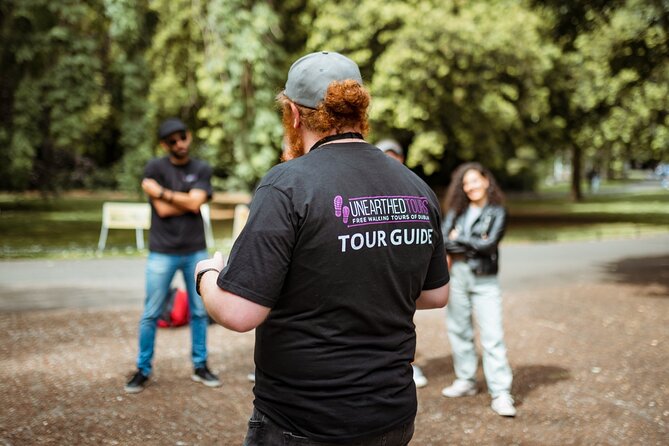
Let’s talk value, not just cost. At $27.82 per person, you’re paying for guidance, context, and a guided route through multiple neighborhoods. That matters in Dublin because the city’s history isn’t tucked neatly in one building—it’s scattered across street corners, statues, church yards, and old courtyards.
What’s included is simple: an in-person tour guide. What’s not included is lunch, and you also shouldn’t assume you’ll enter every major site you see named on the route. In fact, the tour is very clear that you do not enter certain key places like St Patrick’s Cathedral, Dublin Castle, Christ Church Cathedral, and Trinity College Dublin.
So think of this as a smart “outside-and-stops” tour. If you want interiors, you’ll have the right context to pick the best ones afterward (and skip the ones that won’t match your interests).
Starting Near Wolfe Tone and St Stephen’s Green: Dublin’s Stories Start Here

You meet at the Wolfe Tone Sculpture in the St Stephen’s Green area. This is a good way to start because it puts you right in the center of the city’s moving parts, not out on the outskirts where you’d need extra transport.
From there, the tour spends time at St Stephen’s Green, using the park as a springboard into Irish culture and history. It’s a practical choice: parks are slower and calmer than main streets, which gives you a breather while the guide builds the bigger picture.
I also like the pacing here. After the initial context, you’re not immediately hit with a wall of unrelated stops. Instead, you get a framework for what you’ll see later—statues, political references, and cultural cues.
Grafton Street to Molly Malone: The Postcard Dublin, Explained
Next comes Grafton Street, one of Dublin’s busiest high streets. It’s busy in the normal city way, but this stop works because the guide connects the street to the city’s identity, not just foot traffic.
From there, you hit the Molly Malone Statue. This is one of those Dublin icons that people recognize instantly, but the tour adds the context that makes it land differently. You get a better sense of working-class Dublin and why Molly Malone is more than a name on a plaque.
These are short stops, but they’re useful. You’re not just ticking off landmarks; you’re learning what to notice—what kind of person a statue is meant to represent, and what historical thread the guide is pulling through the walk.
Outside the Major Sights: Cathedrals, Dublin Castle, and Trinity from the Courtyards
A big advantage of this tour is that you get close to Dublin’s heavy-hitters without spending the whole day in lines or interior exhibits. But it’s also the main place where you need to set expectations.
Here’s what you should know:
- At St Patrick’s Cathedral, the guide meets you near the gardens and talks history and origins of the city. You do not go inside.
- At Dubh Linn Gardens, you get a look at a picturesque landmark tied to Viking-era Dublin.
- At Dublin Castle, you’re shown the courtyards and the guide explains the history around Northern Ireland and political struggles. You do not enter the castle.
- At Christ Church Cathedral, the focus is the courtyard and outside architecture, including founding details and Viking history. You do not enter the cathedral.
- At Trinity College Dublin, you stop outside, with added context involving the Central Bank area and the Great Irish Hunger (the famine). You do not enter Trinity.
This approach can actually be a win. If you’re on a tight schedule, you can still see the feel and the significance of these places. Then, if one site really grabs you, you can choose to return for an interior visit when you’ve got more time.
The drawback is straightforward: if you were hoping for cathedral interiors or a full castle visit, you’ll need to plan that separately.
More guided Dublin outings with a local





Dubh Linn Gardens: The Viking-Era Clue You’ll Remember
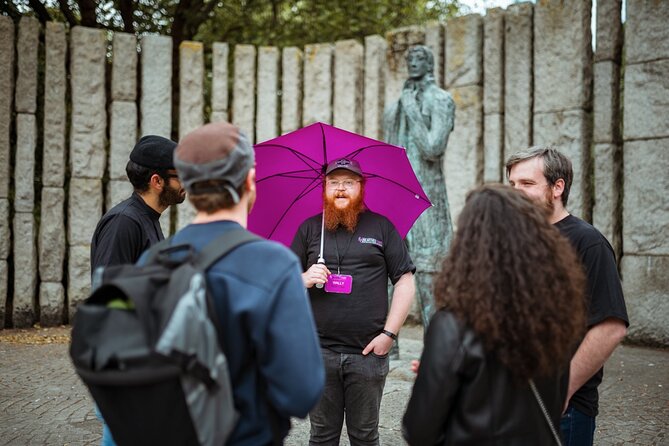
Dubh Linn Gardens is the kind of stop that makes the tour feel grounded. It’s scenic, it’s central, and it carries a deep time story tied to Viking Dublin.
The guide frames it as an important landmark dating back to the Vikings. That matters because Viking-era references can otherwise feel like random trivia. Here, it’s threaded into the larger narrative you’re hearing across the walk.
If you like history that shows up in everyday city spaces—parks, courtyards, and streets—this is one of the more satisfying stops.
Temple Bar and O’Connell Street: Music, Dance, and the Politics of Statues
The tour doesn’t treat Temple Bar as just a nightlife zone. You walk through the Temple Bar neighborhood, and the guide keeps it connected to culture and identity.
There’s also an Irish dance and music element on the route, where the guide talks about Irish dance and music. It’s not a performance, but it gives you a cultural lens for what you’ll see around Dublin later—especially if you’re curious about how tradition and storytelling move together.
Then comes O’Connell Street, another high-impact stop. The guide explores Ireland’s political landscape through the 20th century, using statues along the street as anchors for the story. If you’ve ever looked at a statue and wondered what it’s really referencing, this is where that question gets answered.
Ending at College Green: Wrap-Up Tips You Can Use Immediately
You finish at College Green. From there, it’s a short walk to big transit options like Tara Station or Pearse Station, and it’s close to Grafton Street.
What I like about this kind of ending is that it works like a handoff. The guide gives recommendations on what to do next, where to go, where to eat, and any smaller gems you might miss on your own. If you’re trying to build the rest of your day without overthinking it, this is exactly the moment you want that advice.
Also, finishing near College Green keeps you central for follow-up visits. Many of Dublin’s best “choose your own adventure” moves sit nearby: you can keep walking, hop on transit, or head toward whichever neighborhood matches your mood.
What Makes the Guides Here Work (Kyron, Ciaran, Ciarán, and Keiron)
The guide experience is consistently a highlight. Names you may hear mentioned by other guests include Kyron, Keiron, Ciaran, and Ciarán. Across these different guides, the common theme is clear: they’re local, they connect history to the present, and they’re happy to answer questions instead of reciting a script.
One reason this tour feels better than many “talk at you” walks: the guide’s personality isn’t separated from the facts. You get the sense that the guide wants you to leave with a sharper lens on Ireland—especially independence-era struggles and modern identity—so the city isn’t just scenery.
You can also expect practical conversation. If you tell the guide what you care about, the walk can turn more personal—historical details get selected to match your interest, and the guide can point you to what’s worth your time after the tour.
Who This Tour Fits Best (and Who Might Prefer Something Else)
This is a strong match if:
- You’re visiting Dublin for the first time and want the lay of the land fast
- You like learning history in public spaces—statues, parks, courtyards, and street-level clues
- You want a guided plan that helps you decide what to do next without starting from scratch
This might not be ideal if:
- You came specifically for cathedral interiors, castle rooms, or museum-style stops
- You get worn out by active walking that moves from one central spot to another within a short window
- You only want one neighborhood and don’t care about moving through the wider city center
A quick practical note: you should have moderate physical fitness. That’s typical for a walking tour, but Dublin streets add up—especially when you’re making frequent stops to look, listen, and ask questions.
Should You Book This DayTripper Dublin Walking Tour?
If you want a high-value intro to Dublin, I think this is an easy yes. The 2.5-hour format is long enough to build real context, short enough to keep your day flexible, and the route covers a lot of the city’s most meaningful “read it on the street” landmarks.
Book it early in your trip. You’ll understand what you’re seeing when you go back later on your own. And if you’re the type who likes questions—about Irish history, music, statues, or why certain streets matter—this is the kind of tour that turns those curiosities into clear answers.
If interiors are your priority, treat this as your orientation day, then schedule separate time for the specific places you’ll want to enter.
FAQ
Is the DayTripper Dublin tour in English?
Yes, the tour is offered in English.
How long is the walking tour?
The tour lasts about 2 hours 30 minutes.
What is included in the price?
You get an in-person tour guide. Lunch is not included.
Do we enter St Patrick’s Cathedral, Dublin Castle, Christ Church Cathedral, or Trinity College?
No. The tour does not enter St Patrick’s Cathedral, Dublin Castle, Christ Church Cathedral, or Trinity College. You’ll view them from outside or in nearby courtyards/gardens.
Where do you meet and where does the tour end?
You start at the Wolfe Tone Sculpture in the St Stephen’s Green area. The tour ends at College Green.
Is there a limit on group size and is service available for all travelers?
The tour has a maximum of 25 travelers, and service animals are allowed. The tour also notes a moderate physical fitness level is recommended.
More Dublin Walking Tours






More Tours in Dublin





More Tour Reviews in Dublin



Fresh off the cobbles: the latest Dublin reviews
- Dublin Private Airport Transfer to Ireland
★ 4.5 · 3 reviews - Private Chauffeur Service From Dublin Airport to Killarney
★ 5.0 · 3 reviews - Ireland: 3-Day West Coast Explorer Tour
★ 5.0 · 3 reviews - From Dublin: 4-Day Southern and Western Coast Tour
★ 4.3 · 3 reviews - Dublin : Street Art Walking Tour
★ 5.0 · 3 reviews - Spring Tonic Foraging Tour
★ 5.0 · 3 reviews
City Tours, compared.
 ★ 4.8From Dublin: Cliffs of Moher, Burren & Galway City Day TourFrom $8918,888 reviews
 ★ 4.7Cliffs of Moher, Atlantic Edge & Galway CityFrom $854,293 reviews
 ★ 4.5Dublin to Rock of Cashel, Cork City & Blarney Castle Guided TourFrom $952,536 reviews
 ★ 4.0City Sightseeing Dublin Hop-On Hop-Off Bus TourFrom $322,416 reviews
 ★ 4.1City Sightseeing Hop-On Hop-Off Bus TourFrom $36597 reviews
 ★ 5.0Dublin City Center Walking TourFrom $417552 reviews
 ★ 4.5Cliffs of Moher and Galway City Day Tour from DublinFrom $90351 reviews
 ★ 4.5Boat Trip from Dublin City to Dun LaoghaireFrom $33344 reviews
Browse the lists this tour appears in